Wine writer Jamie Goode, in his book “The Science of Wine,” put it best when he expounded on the miracle of plants creating themselves out of seemingly nothing but air, water, light, and nutrients from the soil. Take that mix of raw materials and chemical processes times 1,368, and you can appreciate the singularity of the vine.
However, sometimes, the vine needs some help when Nature challenges it. That’s how Marquette was born, a blue-black hybrid of Ravat 262 and MN 1094, themselves hybrids. The University of Minnesota developed this grandchild of Pinot Noir in 1989 to endure the harsh northern climate. The winters are the deal-breakers, with the average January low hovering around 10℉.
Hybrid grapes have suffered a bad rap, yet they still take it on the chin and keep producing. Otherwise, we Minnesotans might not be able to know the joy of growing regional grapes and making local wine with a sense of place. My connection with Marquette is an intimate one that I don’t share with any other grape variety. It’s a relationship cultivated by being there when a wine is born.
The Local Wine Experience
Our little neck of the woods is blessed with three local wineries. Each has similar offerings, with a tasting room and events. One implemented something different with its call for volunteers to harvest the berries.
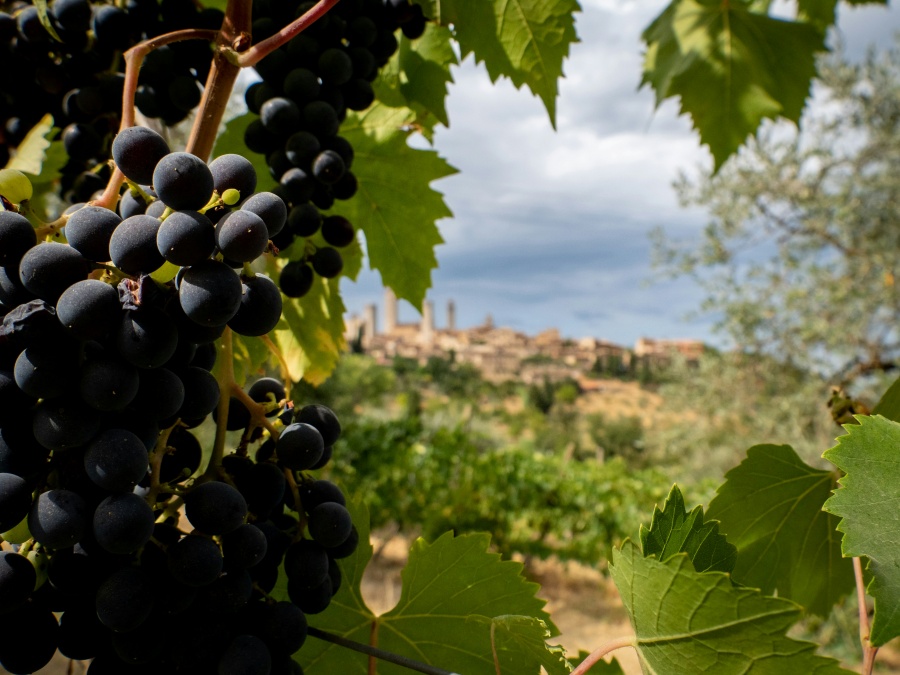
My husband and I signed up with no idea of what to expect on that misty September morning. All we knew was that we were going to pick Marquette grapes. Fortunately, we brought gloves lest we get a crash course on anthocyanins. An employee gave us a tool to cut the bunches and a bin to collect them. We were told we could eat as many grapes as we wanted.
Marquette has smallish berries, but that doesn’t detract from their flavors of black fruits and spice with pleasing acidity. If you’ve never picked grapes, you should try it at least once if just to more fully appreciate the wine in your glass. It’s challenging work that will test your back. Shout out to all the people who help during the harvest!
Three hours and five bins later, we took a break for lunch, feeling a good kind of tired. The staff had piled our take in giant containers. Seeing your hard work is a unique feeling of accomplishment and kinship, as we all snapped photos of them. My relationship with Marquette deepened as I sipped a glass in the tasting room overlooking the vineyard.
Knowing my efforts would appear in subsequent vintages made me feel proud, even if the morning dew had soaked my socks and jeans. The work was hard, but I felt a connection to the grape and its wine as I looked into its inky color. I had never known this feeling. I had helped to make a future vintage. I became part of the wine’s story. And it was the beginning of a beautiful friendship I knew I would always cherish.
Another Harvest, Another Glass of Wine
There was no hesitation in signing up for the harvest the following year. I had to see how the grapes were doing. The year before struck my rookie’s eye as a tough year, with some bunches of rotten and shriveled berries. I came to the vineyard well-prepared with a raincoat and boots this time.
I walked directly to the trailer, picking up a tool and a bin. We picked the early-ripening Marquette again, much to my delight. I was ready to bond once again with my vinous friend. The berries looked big, bursting with flavor. The density of bunches was remarkably greater. It would be a good harvest, judging by the taste of the grapes. While I knew what to expect, it didn’t feel like work as much this time.
The wine tasted even better when we finished for the morning and enjoyed lunch. I bested my five bins with seven this time, making the reward of a meal and a glass of Marquette that much sweeter. We strolled through the rows of vines later as the staff carted the berries to the winery. I realized I knew this wine from the beginning of its journey to the glass. I witnessed its birth.
Marquette had introduced me to a new side of wine. I understood it better, noting the vine’s struggles to make it into the glass. Patches of downy mildew had taken a few, but the others endured, a testimony to their hardiness and all created from the simplest of ingredients. Marquette is a survivor with a promising future. The vines and their wine were indeed miraculous.
As we neared the end of the row, I stopped and touched the rough surface of the vine I had worked on only a few hours before. I was glad we decided to volunteer. The experience was a worthwhile stop on my wine journey. I would never look at a glass the same again. And Marquette had given me that gift of insight and understanding. No other grape had given me a raw glimpse into its soul.
I studied the vine, noticing the canes relieved of their burden and the scattered grapes on the ground for the waiting birds. Their calls filled the air as they anxiously sat perched in the nearby trees. I bent down to gaze into its canopy as I stroked its leaves, still damp from the morning dew. “I’ll see you next year,” I whispered.
Photo by Vindemia Winery on Unsplash