What’s in Your Wine Glass? Learn Its Story.

People drink wine for different reasons. Those of us affected by the bug care a lot more about what is in our wine glass than many others. Of course, it sometimes allows us to fall into that curse of knowledge trap. That’s why this survey from the Wine Market Council was such a surprise.

According to their data, many are not interested in all the details about what is in their wine glass. Sure, they want to know what it is and an idea about what it’s going to taste like. Surprisingly, 19 percent sometimes want to know the type of wine.

Let’s review more of the council’s findings.

What People Sort of Care About Before Buying

Granted that imbibing isn’t necessarily an exploration into all things good and evil. Sometimes, you just want that delicious nectar in your wine glass to take you away from it all.

The things that people want to know about to some degree as the obvious ones like alcohol content and any ratings or reviews on the wine. Try as I may, I still find myself swayed by someone else’s subjective opinion.

Perhaps, it’s intimidating to think about the whole process from vine to bottle. We prefer to stick with the contents of the wine glass instead. That is, after all, the fun part.

As we drill down deeper, interest starts to wane. How was the wine made? I guess. What’s in the wine glass? Huh? How did the grapes make it into the wine glass? You have to ask?

Making Wine an Experience

Few beverages offer the kind of opportunities that wine does. How many drinks come with such fascinating stories? As you gaze into your glass, realize that it’s a window into the past, especially if you have an Old World wine.

Many wineries in Europe are hundreds of years old with the business passing down through multiple generations. When you drink a glass of one of these wines, you are tasting history—literally!

That’s where you can do some exploring. Wine-Searcher.com is an excellent place to start. You can learn so much about the wine, including

  • Grape variety(s)
  • Country and region
  • Producer information
  • Where to buy

I’d recommend doing a deep dive into the region, the terroir, if you will. Find out what kind of soil it has. Learn about its climate and how the weather has been for the vintage year. It can provide some incredible insights into why the wine tastes like it does.

Then, pull out your handy copy of “The World Atlas of Wine” and delve into the landscape some more. There is a treasure trove of information waiting for you to discover.

Savoring the History in Your Wine Glass

It doesn’t matter if you’re drinking red, white, or rosé. Somewhere there is a story waiting for you. I’m willing to bet you’ll find the wine more enjoyable by taking the time to get to it better. It has a lot to tell you.

Photo by Corina Rainer on Unsplash
More Wine Books to Enjoy

I love wine books. I enjoy the stories of which there are thousands. You’ll never look at your wine glass in the same way after learning the who, when, where, and how of each bottle you open.

Other books are inspirational in different ways. The first book on my list is one of those picks. It gave me the inspiration to get my WSET-Level 1 and to pursue the CSW.

If you read just one book about wine, then the “Wine Bible Revised” by Karen MacNeil should be it. Her descriptions are lyrical as she makes wine sound so romantic and dreamy. You’ll learn so much from this book.

More Wine Books

My library of wine books continues to grow. Place names and geography are sometimes intimidating. That makes a book like “Wine For Dummies” so refreshing. It takes complex subjects and makes them accessible.

If you’re ready for a mini tour of the wine world, you couldn’t find a better read than “Kevin Zraly Windows on the World Complete Wine Course.” It provides succinct information along with wine recommendations and quizzes to test your knowledge. A fun book!

If you want to look under the hood, you can’t do much better than David Bird’s, “Understanding Wine Technology: The Science of Wine Explained.” The science end of things is heavy, but Bird brings it to a level that makes it easy to understand.

For Your Reference Library

There are a few must-haves for any wine enthusiast to have, starting with the “The World Atlas of Wine 8th Edition” by Hugh Johnson and Jancis Robinson. This book puts you right in wine country with detailed accounts of the land and terroir.

If you want to jump in the deep end of the pool, then Jancis Robinson with Julia Harding and Jose Vouillamoz’s “Wine Grapes: A Complete Guide to 1,368 Vine Varieties, Including Their Origins and Flavours” is for you. You’ll never be a loss about a wine again.

Just for Fun

Wine books to learn more about this delightful beverage are excellent ways to test your knowledge. But wine also has a lighter side to explore with books like “Wine Cats.” Take a sip of wine every time you say, “Awww-www.”

Wine books are a great escape that take you away for just a bit so that you can enjoy the moment and breathe. I think Benjamin Franklin summed it up best when he said,

Wine makes daily living easier, less hurried, with fewer tensions and more tolerance.

Photo by Kathy Lee on Unsplash

Recommended Wine Books to Keep You Sane

Before the Earth stopped in Minnesota (March 17, 2020), I remember telling my friends gathered at our local watering hole that it felt kind of cool to be living history. As the days roll on, wine books are becoming my new best friend.

It starts easily enough. You read a blog post or an article that mentions a certain book. Then, it’s a search on your library’s website for hopefully an e-book that you can start reading right away.

But then it goes on when…

I read the bibliography. Now there are dozens of other wine books to find. And of course, once you find an author you like, all of his books are must-reads.

There could be worse obsessions.

Learning the Wine Business

As far as the wine business goes, I’m on the consumer end of things. I’ve worked retail like many of you. You probably have a good idea about how that operates.

But, if you haven’t looked under the hood at the wine industry, hold on to your hat! There’s a lot going on that change the way you think about this magical beverage.

Three excellent books that will surprise and delight you include:

All three are by wine economist, Mike Veseth. I won’t reveal some of the more shocking tidbits. I’ll leave that for you to discover. Suffice to say that big business doesn’t even scratch the surface.

Wine Books for Reference and Fun

These these books are handy to have around when you need to look up something or to refresh your memory. If you want to know more than “Yes, it’s a red wine from France,” they will bring you up to speed in style.

The book, “Oz Clarke: Grapes & Wines: A Comprehensive Guide to Varieties and Flavours,” is my tome of choice when I want a succinct description of a grape variety, especially a new one.

Oz Clarke’s “World of Wine: A Grand Tour of the Great Wine Regions” is another joy to peruse when you want to know about the place or terroir. You’ll learn about the land and what makes it unique to help you appreciate the wines better.

This one is for pure fun. It also sent me on a hunt for books to experience them fully in ways I hadn’t considered before. That’s what makes “The Booklovers’ Guide to Wine: An Introduction to the History, Mysteries and Literary Pleasures of Drinking Wine” so delightful.

It’s the kind of book you could read again and again and still get something new out of it.

Final Thoughts About Wine Books

The great thing about wine books is how they transport you to different places. For just a little while, you can think about something else instead of the news.

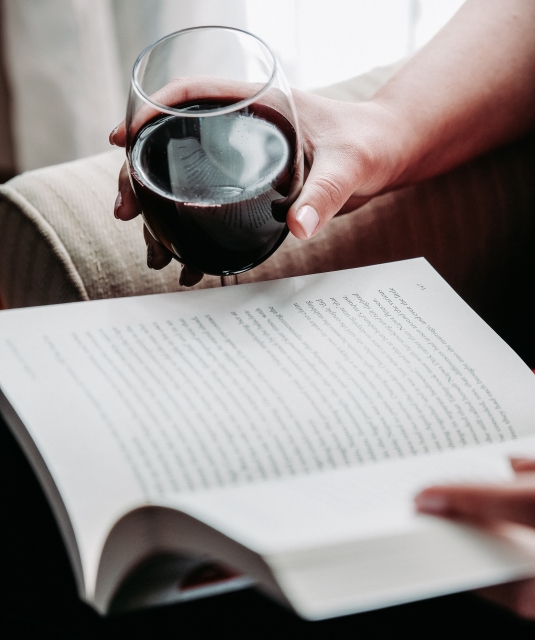
Do yourself a favor tonight. Turn off the TV. Put on some relaxing tunes. Pour yourself a glass of wine and lose yourself in a book. The adventure awaits.

Photo by Jeff Siepman on Unsplash

Are You a Wine Snob?

Today, I started my CSW wine prep class. We began the discussion at its logical starting point with wine chemistry and the constituents of wine. It’s amazing to think of all those reactions going on in the glass. It made me wonder if that makes me a wine snob.

Food for Thought

Part of the reason it came to mind was a section in Michael Steinberger’s pithy book, The Wine Savant: A Guide to the New Wine Culture. He begins with a discussion of how non-oenophiles might view us, wine enthusiasts.

Yes, there is a mystic, if you will, about wine. You have only to look at how some people have left other careers to follow the Muse, such as Master of Wine, Jennifer Simonetti-Bryan.

It’s an easy path to follow.

Wine isn’t just a beverage you toss back after a tough day at work, although, you certainly could. But, it’s so much more than that.

What Is the Magic Behind Wine?

It begs the question, what is it about wine that makes us swoon?

It could be the history. Wine does go back over 6,000 years. There aren’t a lot of other beverages that have that kind of resume. But, there are other things too.

It has a certain romance about it.

It’s esoteric, if you take the wine snob route.

Wine has all those grapes to choose from and all those countries providing them.

I came back to an excellent point made in Steinberger’s book…

Wine Appreciation

Wine is unique in this whole association with snobbery. We don’t call out enthusiasts or experts in other cultural arts for their knowledge. We don’t call art lovers, snobs, nor musicians.

I think there are two factors at work in this arena. Both feed each other to create this monster as “one who has an offensive air of superiority in matters of knowledge or taste.”

First, there is this behavior that creates an unpleasant atmosphere. No one likes to be put down for what they don’t know or perhaps don’t care about.

Their loss.

There is also another force at work, I suspect. That is the dreaded curse of knowledge. That is the fallacy whereby a person may forget what it was like not to know something. When they discuss it, they use jargon and language they assume that others grasp too.

You’ve probably had at least one college professor guilty of that one.

Then, you throw in a bit of the Dunning-Kruger Effect where someone knows enough to be dangerous and far too simplistic in the greater context.

How Not to Be a Wine Snob

If you study wine, something happens that puts you in your place…

You soon realize that the more you know, the more you need to know.

Wine is a complex topic that crosses into many fields, such as viticulture, politics, ideology, history, and a whole lot more. Generalizations are not recommended. I’m reminded of a lovely quote by journalist, H.L. Mencken who said,

Explanations exist; they have existed for all time; there is always a well-known solution to every human problem—neat, plausible, and wrong.”

Final Thoughts About Being a Wine Snob

Therefore, my solution for casting snobbery to the curb is to remember that wine is just as complicated in its reality as it is in the glass. There’s no need for haughtiness or proving yourself. Chill out and enjoy it.

However, if truth be told, I relish being called a wine snob just as much as I love being branded a science nerd. Always remember that friends don’t let friends derive drunk.

Photo by Theme Photos on Unsplash