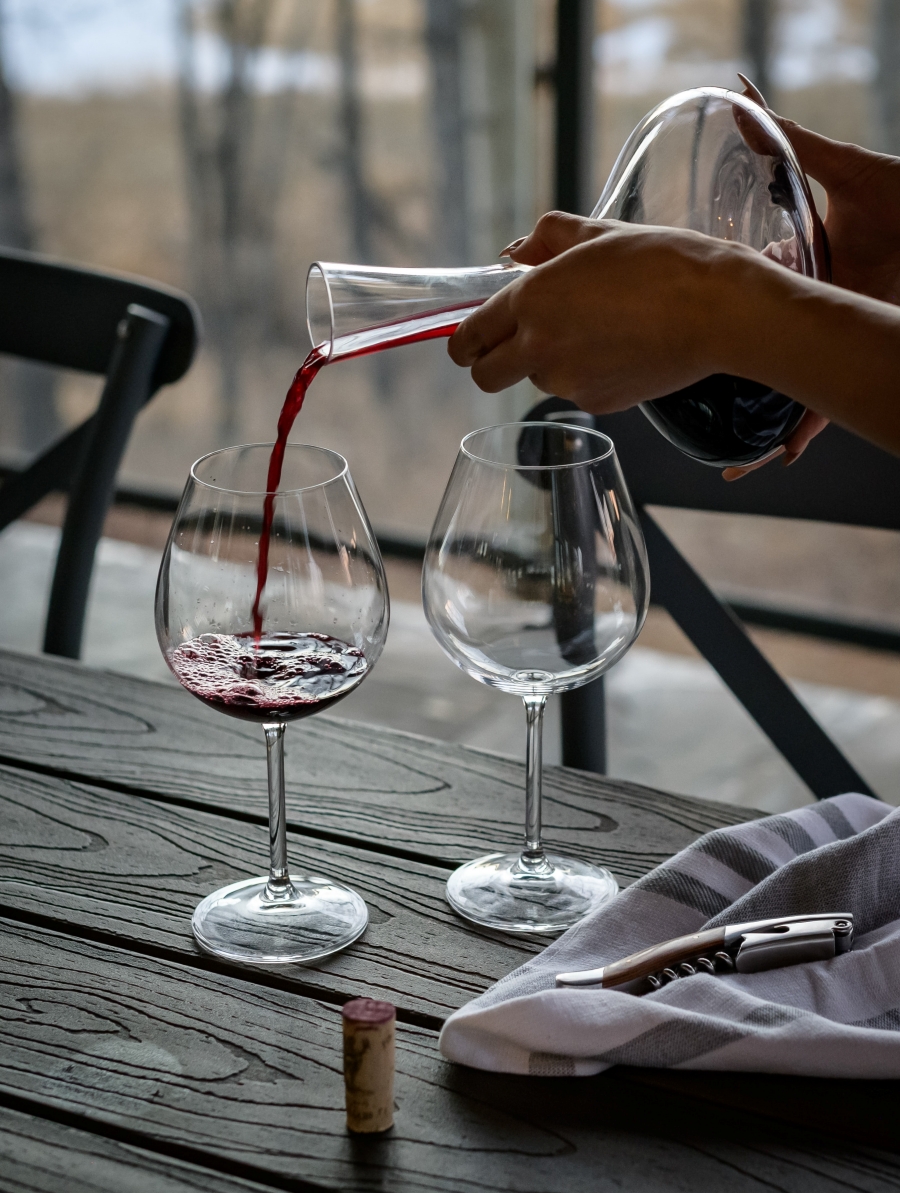
If wine is your pleasure, you are in good company with over one-third of Americans who drink making it their libation of choice. She is a beguiling temptress with lots of wine trivia to share.
Robert Louis Stevenson, Thomas Jefferson, Ernest Hemingway, and even Jimi Hendrix among millions of others have fallen under her spell. It’s easy to see why. No other beverage can challenge and mystify you with its complex aromas and flavors.
But this seductress has her secrets.
Wine has many faces, judging by the numerous varieties. Some have pseudonyms. Others have thrived and attained noble status, whereas others are content to complement the local fare. But there is so much more to tell than what is on the bottle’s label that makes wine trivia fun.
1. Wine Has a Fraction of the Sulfites Compared to Other Foods and Beverages.
Everyone has seen the phrase, “Contains Sulfites” on a bottle of wine. Though rare, it can cause severe asthma symptoms in sensitive individuals.
The FDA pushed the labeling requirements after a surge in the use of sulfites as a preservative in the 1970s followed by an uptick in reported cases. Winemakers use it to control fermentation and prevent the wine from turning into vinegar.
However, wine is not the only thing that contains sulfites. It is actually hard to avoid since it is a by-product of fermentation.
You will also see it in many processed foods, including pickles, jams, canned vegetables, and even instant mashed potatoes. Dried raisins, for example, contain a whopping 1,250 ppm. The threshold for labeling is 10 ppm or higher.
2. Port Wine Grapes Are Still Stomped the Old-Fashioned Way.
The romantic image of a vineyard with workers stomping grapes still exists in Portugal. The entire process is a testament to the care that the vintners take to produce their wines.
Grapes are hand-harvested which protects them and also allows for some pre-screening of only the best. Then, it is into the lagares or treading tanks where they are crushed by foot.
The treaders follow a set routine to extract as much juice as possible but in a gentle way. First, they lock arms and trod on the wine in unison in a stage called the corte.
Next, it is the freestyle in the Liberdade stage with everyone taking their own stab at it. Then, the magic begins with the start of fermentation and fortification with a neutral spirit. The wine rests until the following spring when the vintners will then continue with the winemaking process.
3. Wine Origins Starts With the Animal Kingdom.
My favorite piece of wine trivia isn’t about wineries and varietals.
Wine began as a happy accident at least for the primates and shrews that stumbled upon fermented fruit. Humans got into the act about 7,000 years ago, based on archaeological evidence from Iran’s Zagros Mountains.
The shards and resin residue suggest that the people made the nectar intentionally instead of it being a spontaneous occurrence.
It did not take long for the secret to spread. Researchers have found early evidence in Egypt, Georgia, and Turkey. Today, there are between 5,000 and 10,000 different grape varieties, depending on who you ask.
Many indigenous grape varieties stay at home for local consumption. Others have fallen into obscurity. The rest, as they say, is history.
4. A Bug Almost Destroyed the Wine Industry.
The European wine industry took off in the 1700s and 1800s. To keep up with the demand, France turned to America for vine stock. Inadvertently, the imports brought along a pest, a louse called phylloxera.
The American vines were resistant to it. However, it decimated the French vineyards, almost bringing them to their knees. The insect attached the roots and virtually starving the rest of the plant.
Vintners tried creating hybrids with no luck. There was even a reward offered to find a solution. The tide changed when they grafted American rootstock with French vines.
France was not the only country to suffer from the near devastation. Phylloxera nearly swept the globe, sparing few places including Chile. To this day, there is no pesticide or cure as California found out in the 1980s.
5. Spain Has the Most Vineyard Land in the World.
Some people think France or even the United States has the most land under vine. That honor actually rests with Spain. The country’s area for 2017 was a staggering 2.4 million acres.
China was second and the United States, sixth. Spain alone makes up 13 percent of the total global vineyard. It also exports the most wine, accounting for over 20 of the total global export volume.
Airen, by far, is the most widely grown grape in Spain and the world. You are not likely to find a bottle at your local wine shop.
The majority of production goes into Spanish brandy. Vintners use it primarily as a blending grape. That is probably the reason that it has the nickname, Burra Blanca or white donkey. Tempranillo, Spain’s signature grape variety, is a distant second.
6. Many of the Most Common Grapes Can Trace Their Heritage to the Co-Called Casanova of Grapes.
The world of wine has its stories that are whispered behind closed doors too. You probably will not know the name of this grape variety.
But Riesling, Chardonnay, Gamay and upward of 80 others are among the progeny of the prolific, Gouais Blanc. As they say, it takes two to tango. So, there is also another obscure, fruit, Savagnin, not to be confused with Sauvignon Blanc and—gasp!—Pinot Noir.
How’s that for some wine trivia?
Switzerland produces the most wine of this grape with some plantings in Australia and Germany. Like Airen, Gouais Blanc is not necessarily a household name. It is a simple wine on its own. It makes its living as a blending grape. Perhaps it prefers to step back and let its progeny take the limelight.
7. One of the Most Renowned Vineyards in the World Has Over 80 Owners.
Clos de Vougeot is a Grand Cru vineyard in the region of Burgundy in France. One of its claims to fame is that over 80 people have a stake in the 125-acre plot—literally!
The reason is because of the Napoleonic Code of 1804. Napoleon Bonaparte spearheaded the creation of a new legal framework that changed post-revolutionary France forever.
One of the provisions of the new system was that all children inherited equally after the death of their parents. The result was fragmented vineyards with some only owning a row or two of vines.
However, that’s not unusual. Having just one owner is the anomaly. Interestingly, they are called monopoles or monopolies in English. Wine trivia at its best!
8. The Most Expensive Bottle Takes a Page from History for This Wine Trivia Tidbit.
Rare vintage wines command a high price. Yet, winemaker, Loïc Pasquet of Liber Pater, is poised to take the wine world by storm. The vineyard produced only 550 bottles of its 2015 Bordeaux.
Several things set it apart from your average Graves red. In many ways, it is a winemaker’s wine with elements that an enthusiast can also appreciate.
The vines on which the grapes grew are ungrafted, harkening back to the pre-phylloxera days. It also draws on Bordeaux’s origins with rare grape varieties indigenous to France but seldom seen anymore such as St-Macaire.
The wine is also vinified and aged in clay amphorae. These two-handled vessels are the stuff of ancient Greece. The 2015 Liber Pater will fetch $33,420 per bottle.
9. Dom Pérignon Did Not Invent Champagne.
Dom Pérignon may make some of the most delightful sparkling wines on the planet. But, the Benedictine monk did not come up with the magic formula.
Instead, he perfected parts of the process that eventually made Champagne what it is today. Fermentation in the bottle occurred unexpectedly, causing it to explode. Vintners search for a solution to this volatile problem that was tapping into over 20 percent of their production.
First, Dom Pérignon refined winemaking with a careful selection of grape varieties. He also blended them while refining a way to press them to minimize the bitter tannins and get a white wine from red grapes.
No one had done it before. But what about the bubbles? Stronger, wood-fired glassware from local craftsmen solved the problem of the le vin du diable, or “the devil’s wine.”
10. Some of the World’s Best Wine Is Also the Most Counterfeited.
Château Le Petrus produces some of the exquisite—and most expensive—wines from Bordeaux in France. It’s the quintessential lesson in less is more. The 28.4-acre vineyard is unique for many reasons.
First, it is planted entirely with Merlot grapes. Most Bordeaux wines are a blend of two or more. The vintners pulled up the last of their Cabernet Franc vines, the only other variety planted.
Most of the vines are around 40 years old. While they produce less, the juice is concentrated and bursting with flavor. Every single grape or berry is hand-picked.
It can take several days to complete the harvest or a single one if the weather cooperates. Le Petrus is the definition of terroir with its one-of-a-kind blue clay soils. They are unusual for their color and chemical properties.
The entire vineyard rests on top of these soils. They challenge the grapes with their impermeability. The result is wines with powerful tannins that enhance their aging potential.
They reach their pinnacle of complexity and richness only after 15 to 45 years of aging. Opening a bottle earlier will reveal a petulant wine that will insist on decanting for a few hours.
It is no wonder that these wines command the high prices they get. It also explains their desirability on the legitimate and black markets.
Two-star Michelin restaurant, Maison Rostang, learned their value first hand after the recent theft of Le Petrus wines among other irreplaceable bottles earlier this year. The vineyard produces a mere 2,500 cases per year. The average price of a bottle is $3,244.
Photo by Road Trip with Raj on Unsplash